


Stop Overcomplicating: Simpler Processes Work Better for Everyone
Complexity is often mistaken for refinement, especially around Standard Operating Procedures (SOPs). But if you’ve ever found yourself lost in a binder full of complicated SOPs that no one ever reads, you’d probably agree that simpler is almost always the better option.
What Are SOPs?
Standard Operating Procedures (SOPs) are documented best practice processes that a company has in place to ensure services and/or products are fulfilled and delivered consistently every time a sale is made. When SOPs are correctly implemented and used, they provide clarity, consistency, and efficiency.
The Problem with Most SOPs
The truth is, most SOPs are either out of date or nonexistent. But, even when they do exist, they’re often buried in a bulky binder gathering dust on a shelf—hardly an efficient system for our teams to use that would ensure their success.
For SOPs to be useful, they must be easy to access, quickly searchable, and up-to-date. The obstacle often isn’t a lack of information; it’s the over complication and inaccessibility of that information.
The Criteria for Effective SOPs
To make your SOPs truly useful, they should meet the following criteria:
Accessible
Everyone should be able to access your SOPs from various devices, where the processes are taking place, not just from a binder that sits on a shelf.
Up-to-date
SOPs need regular reviews and updates to reflect changes in people, process, and technology. Depending on the maturity of your business, I would recommend quarterly to as long as 18 months in between review cycles.
Searchable
Time is money. Everyone should be able to quickly search the entire library of SOPs to find exactly what they need, when they need it, where they need it.
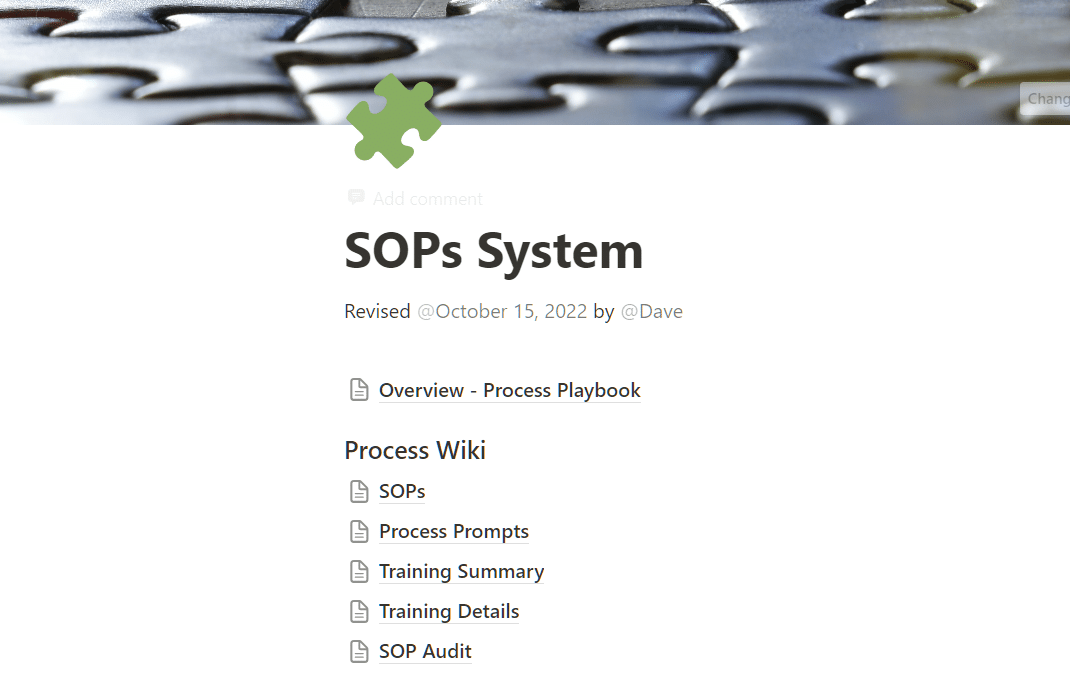
The SOP Management System we currently use to accomplish this for ourselves and our clients is built out in a tool called Notion, but you can easily create a system that accomplishes this using several other technology platforms.
Here is a screen grab of our current SOPs System:
The Anatomy of a Simplified SOP
While many SOPs are written in complicated jargon and lengthy paragraphs, the most effective ones are easy to digest. A simplified SOP should include:
- Long-form Writing: Detailing the steps in an easy-to-understand manner.
- Supporting Media: Use videos, images, or diagrams to provide a visual understanding of the process.
- Process Prompt Checklists: Summarize the steps in a checklist format for quick reference during execution. Here is a step-by-step guide you can follow to create your own process prompts checklist.
Easy to use SOPs Template
The template we use for ourselves, and our clients has 3 main sections:
- Header: This has all the information you’d expect. Name of the SOP, Department, Work Center, Date Created, Date Modified, Next Review, Current Status.
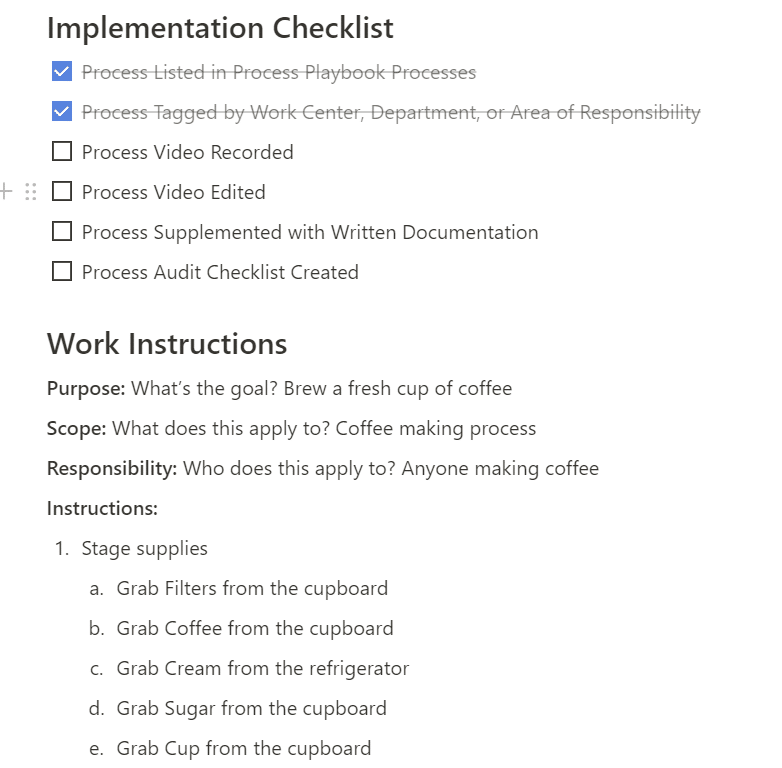
- Implementation checklist: This is a brief checklist we have implemented to ensure our process for creating SOPs is completed.
- Work Instructions: This is where you document the specific steps needed to accomplish the goal of the SOP.
Here is a screen grab of the checklist and work instructions:
Final Thoughts
Simplifying your SOPs can drastically improve their usefulness and your team’s efficiency. An SOP that’s easy to access, easy to understand, and easy to execute is infinitely more valuable than a complicated one that’s ignored. After all, the ultimate goal of an SOP is to help your team do their jobs better. Are your SOPs serving that purpose, or are they making things more complicated than they need to be?
That’s it for today.
See you all again next week!
Dave
Ready to see what's holding your operation back?
Take the Operations Diagnostic: your top 3 priorities, plus a quick win for each. I personally review every one and send your insights within 24 hours.
Already know you need a hand? Let's Talk → 20-Minute Strategy Call