

Balancing Continuous Improvement and Efficiency
As leaders, driving efficiency often takes center stage in our efforts for achieving continuous improvement results. However, we must recognize that focusing solely on efficiency activities can force us to overlook our most vital asset: our teams.
Our people are not just an expense number or a cog in the machine; they are the central driving force behind every achievement and innovation in our business. Sometimes I think as we ascend in our leadership roles it’s easy to forget that we are people too. We’re no better because we have different titles and responsibilities; we are all a critical part of the systems we are building. The reality is that any system is simply impossible to operate without the right people.
Continual Layoffs and the Illusion of Efficiency
The headlines are filled with stories of mass layoffs across various sectors, painting a troubling picture of the current business landscape. Having been faced with these difficult decisions myself, I understand that these decisions, though tough, are sometimes necessary. However, a closer look often reveals that these drastic measures stem not from a shift in business climate but from fundamental flaws in both the strategic planning and hiring processes. For me, it underscores the reason that people continue to feel as though they are merely cogs in the wheel, and completely expendable in the pursuit of short-term gains.
But what real gains do these companies achieve following such disruptive changes? Can an organization genuinely create a culture of continuous improvement coming out of this type of disruption? For many, unfortunately, the answer is a resounding “No.”
These layoffs often signify not a strategic pivot but another turn in a cycle of churn, a knee-jerk reaction rather than a thoughtful recalibration. Despite what their marketing and leadership language might suggest, these organizations show little genuine interest in nurturing a culture of continuous improvement. Instead, they are caught in a short-sighted loop, focusing on immediate gains while undermining the long-term health and resilience of their operations.
Emphasizing People in the Culture of Continuous Improvement
The true essence of a culture of Continuous Improvement (CI) lies not in the efficiency of the systems we create but in the value we place on our teams. It’s about providing the necessary tools and support to not only achieve our operational goals but also to empower and engage every member of the organization. I recently came across this tweet:
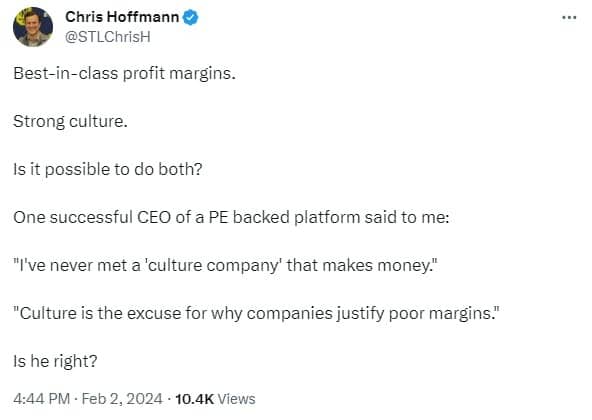
My perspective is that this type of thought process often arises from an outdated, top-down approach to management, but today’s business climate demands a different mindset.
The truth is that people want to feel connected to something greater than their job description. They seek recognition for their efforts and want to know that their work makes a tangible difference. When these fundamental needs are unmet, their commitment and output inevitably suffer. This often leads to a cycle of understaffing and overworking, followed by layoffs when the pressure becomes unsustainable, only to begin the cycle anew when the realization hits that the company cannot meet its goals with a disengaged workforce.
Creating a Sustainable Culture of Profitability and Engagement
Creating a culture where strong morale and high profit margins coexist is not just a lofty ideal; it’s a practical, achievable goal. It’s simple but not easy. It requires a deep understanding of the intrinsic and extrinsic motivations of our workforce, a commitment to genuine engagement and empowerment, and the courage to make decisions that may go against the grain of traditional business practices. I know it’s possible because I’ve been part of this transformative journey in several businesses now, where we’ve managed to cultivate an environment where profitability and cash flow are natural byproducts of a motivated, engaged, and efficiently operating team.
Final Thoughts
Focusing solely on efficiency in our continuous improvement efforts can lead us to overlook the most critical component of our business: our people. As we continue to strategize and navigate, it’s critical that we foster a culture where continuous improvement is not just about refining processes and cutting costs but about creating an environment where every team member feels valued, engaged, and aligned with the company’s mission and goals. If we do this, we will set the stage for a sustainable business model where profitability and a positive company culture go hand in hand.
That’s it for today.
See you all again next week!
Dave
Ready to see what's holding your operation back?
Take the Operations Diagnostic: your top 3 priorities, plus a quick win for each. I personally review every one and send your insights within 24 hours.
Already know you need a hand? Let's Talk → 20-Minute Strategy Call